Clothing Manufacturing and Shipping from Pakistan
One of the first questions any international buyer asks after deciding to source from Pakistan is: how long is this actually going to take? It is a fair question, and the honest answer is that it depends on several factors. But “it depends” is not useful on its own, so this guide breaks down every stage of the process with realistic timeframes so you can plan your orders properly and avoid the most common scheduling mistakes.
Whether you are ordering activewear, jackets, caps, or training wear, here is what to expect from inquiry to delivery.
The Full Timeline at a Glance
Before diving into each stage, here is a rough overview of the complete process from first contact to goods arriving at your door:
- Initial inquiry and quotation: 2 to 5 days
- Sample development: 7 to 21 days
- Sample revision (if needed): 5 to 10 days per round
- Order confirmation and deposit: 1 to 3 days
- Bulk production: 25 to 45 days
- Quality inspection and packing: 3 to 7 days
- Sea freight to Europe: 20 to 30 days
- Sea freight to the US East Coast: 25 to 35 days
- Sea freight to the Middle East and Gulf: 10 to 20 days
- Air freight (any destination): 3 to 7 days
- Customs clearance at destination: 3 to 10 days
For a standard first order using sea freight to Europe, you are looking at a realistic total timeline of 10 to 14 weeks from first contact to delivery. Once you have an established relationship with a manufacturer and your samples are already approved, repeat orders can be completed significantly faster.
Stage 1: Initial Inquiry and Quotation (2 to 5 Days)
The process begins the moment you send your first inquiry. A good manufacturer will respond within 24 to 48 hours with initial questions about your product requirements. Once you provide your specifications, fabric preferences, quantities, and any reference images or tech packs, they will come back with a quotation.
This stage typically takes 2 to 5 working days. Delays here are usually caused by incomplete information from the buyer. The more detail you provide upfront, including product type, fabric specification, colour, customisation requirements, and target quantity, the faster and more accurate your quote will be.
At Vertigo, we aim to respond to all inquiries within 24 hours and provide detailed quotations within 2 to 3 working days for straightforward orders.
Stage 2: Sample Development (7 to 21 Days)
Once you approve the quote and pay any applicable sample fee, the manufacturer begins developing your sample. This is where your product comes to life for the first time.
Sample development timelines vary based on product complexity:
Simple products like basic caps, plain fleece hoodies, or single-colour tracksuits can be sampled in 7 to 10 days.
Mid-complexity products like cut-and-sew activewear sets, printed training wear, or softshell jackets typically take 10 to 14 days.
Complex products like fully sublimated multi-panel activewear, technical outerwear with bonded seams, or safety jackets requiring certified materials can take 14 to 21 days or longer.
Do not rush this stage. The sample is your opportunity to catch problems before they become expensive. A thorough sample review now saves weeks of dispute resolution later.
Stage 3: Sample Revision (5 to 10 Days Per Round)
It is rare for a first sample to be perfect. Most buyers request at least one round of revisions, whether that is adjusting a measurement, tweaking a colour, changing a print placement, or modifying a fit detail.
Each revision round adds 5 to 10 days to your timeline. If you anticipate needing multiple rounds, factor this in from the start. Two revision rounds on a mid-complexity product could add three weeks to your overall schedule before bulk production even begins.
The best way to minimise revision rounds is to provide extremely clear and specific feedback. Reference measurements in centimetres, use Pantone codes for colours, and include annotated photos wherever possible. Vague feedback leads to guesswork, which leads to more rounds.
Stage 4: Order Confirmation and Deposit (1 to 3 Days)
Once your sample is approved, you confirm the bulk order in writing and pay the agreed deposit, typically 30 to 50 percent of the total order value. Most manufacturers will not begin bulk production until the deposit is received and confirmed.
Bank transfers between international accounts can take 1 to 3 working days to clear depending on the banks involved. Some delays happen here simply because buyers take time to process payment internally. If your business has a finance approval process, factor that into your planning.
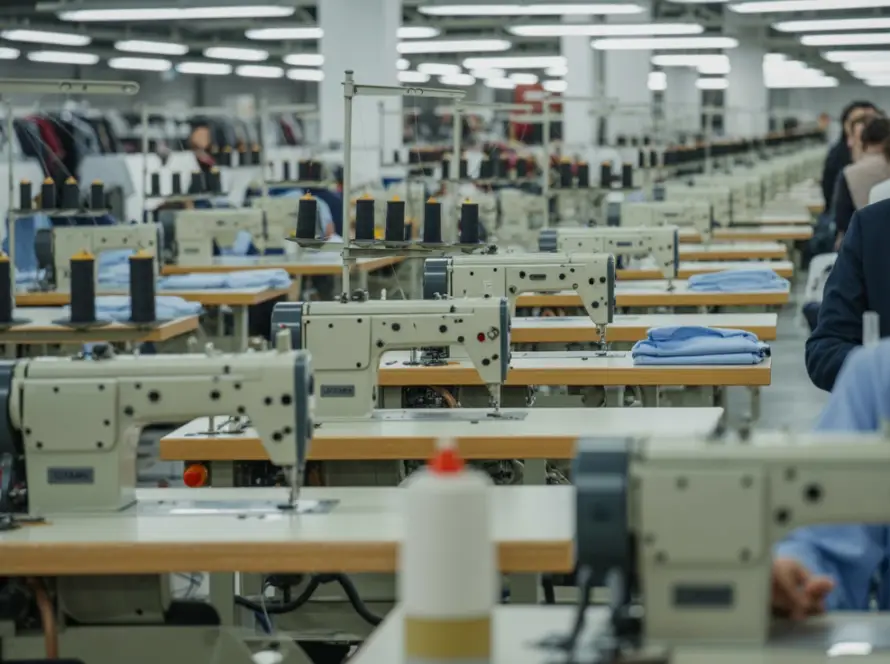
Stage 5: Bulk Production (25 to 45 Days)
This is the longest single stage of the process. Once the deposit is received and production is scheduled, manufacturing a bulk clothing order from Pakistan typically takes 25 to 45 working days.
Several factors affect where your order falls within that range.
Order volume. A 500-piece order will be completed faster than a 5,000-piece order, all else being equal.
Product complexity. Technically complex garments with multiple components, special fabrics, or detailed finishing require more time on the production line.
Factory workload. If the factory is running at full capacity when your order is placed, your production start date may be pushed back. This is why booking your production slot early matters, especially around peak seasons.
Fabric availability. If your order requires a specific fabric that needs to be sourced from a mill, fabric procurement adds time before cutting even begins. Standard fabrics that a factory keeps in stock do not cause this delay.
Peak seasons. Pakistani factories tend to be busiest in the lead-up to the winter buying season (August to October) and around major religious holidays including Eid. If your order falls during these periods, add extra buffer time.
A useful rule of thumb: plan for 35 days as your baseline for bulk production, then adjust up or down based on your specific product and order size.
Stage 6: Quality Inspection and Packing (3 to 7 Days)
Before goods are shipped, they go through a final quality inspection and are packed into cartons for export. This stage typically takes 3 to 7 days depending on order size.
If you have arranged for a third-party inspection through a company like QIMA or SGS, schedule this inspection for the day before your goods are due to be packed. The inspector will need access to the factory and a sample of cartons to check. Build the inspection into your timeline rather than treating it as an afterthought.
Stage 7: Shipping from Pakistan to Your Destination
Shipping is where timelines vary the most depending on your chosen method and destination. Here is a detailed breakdown.
Sea Freight
Sea freight is the most cost-effective option for bulk orders and is the standard choice for most international buyers. Goods are shipped from Karachi, Pakistan’s main export port, to destination ports around the world.
To Europe (UK, Germany, Netherlands, France, Spain): 20 to 30 days transit time. Rotterdam, Felixstowe, and Hamburg are common destination ports.
To the US East Coast (New York, Savannah, Charleston): 25 to 35 days transit time.
To the US West Coast (Los Angeles, Long Beach): 20 to 28 days transit time via the Suez Canal or 28 to 35 days via the Cape of Good Hope depending on routing.
To the Middle East and Gulf (Dubai, Jeddah, Dammam): 10 to 20 days transit time. This is the shortest sea freight route from Pakistan.
To Australia and New Zealand: 20 to 30 days transit time.
To Canada: 25 to 35 days to East Coast ports, slightly less to West Coast.
These are port-to-port transit times. They do not include the time it takes to move goods from the factory to the port in Pakistan, which typically adds 1 to 3 days.
Air Freight
Air freight dramatically reduces transit time but at a significantly higher cost per kilogram. For most bulk clothing orders, air freight is only financially practical for smaller quantities, urgent replenishment orders, or time-sensitive launches.
Transit times from Pakistan by air are typically 3 to 7 days to most major destinations worldwide including Europe, the US, the Middle East, and Australia.
If you are considering air freight, get a quote early and compare the cost against the commercial value of receiving your goods faster. For seasonal products or promotional deadlines, the premium can be worth it.
Consolidation and LCL Shipping
If your order does not fill a full shipping container, your goods will be shipped as LCL (Less than Container Load), consolidated with other exporters’ cargo. LCL shipments are slightly slower than FCL (Full Container Load) because of the additional handling at consolidation points. Add 3 to 7 days to the standard sea freight times above for LCL shipments.
Stage 8: Customs Clearance at Your Destination (3 to 10 Days)
Once your goods arrive at the destination port, they need to clear customs before they can be released to you or your freight forwarder. Customs clearance typically takes 3 to 7 days for straightforward shipments, but can extend to 10 days or more if your shipment is selected for inspection or if documentation is incomplete.
To avoid delays at customs, make sure your shipping documents are accurate and complete. These include the commercial invoice, packing list, bill of lading, certificate of origin, and any product compliance certificates required by your country. Your freight forwarder or customs broker can guide you through the specific requirements for your destination.
European buyers should note that Pakistan’s GSP+ status reduces import duties on textile and garment imports. Make sure your certificate of origin is in order to benefit from these preferential rates.
How to Build a Realistic Production Calendar
Given everything above, here is how to build a realistic calendar for a standard first order from Pakistan using sea freight to Europe.
Work backwards from the date you need goods in hand. If you need your activewear in stock by the start of a season, count back through each stage:
- Customs clearance: allow 7 days
- Sea freight to Europe: allow 28 days
- QC and packing: allow 5 days
- Bulk production: allow 35 days
- Deposit and production scheduling: allow 3 days
- Sample revision (one round): allow 7 days
- Sample development: allow 14 days
- Quotation and initial inquiry: allow 3 days
Total: approximately 102 days, or just under 15 weeks from first contact.
That means if you want goods ready in time for a spring season launch, you need to be placing your inquiry in late autumn at the latest.
Common Mistakes That Delay Orders
Even buyers who understand the basic timeline make avoidable mistakes that push their delivery dates back. Here are the most common ones.
Starting too late. This is the number one cause of delays. Buyers who discover Pakistan as a sourcing option and expect to have goods in hand within four to six weeks are setting themselves up for frustration. Start earlier than you think you need to.
Taking too long to approve samples. Every day a sample sits on your desk waiting for feedback is a day added to your timeline. Review samples quickly and give detailed written feedback the same week you receive them.
Delaying deposit payment. Factories will not start production without a deposit. Internal payment approval processes that take two weeks can push your production start date back significantly.
Not booking your shipping early. Container space, especially during peak season, needs to be booked in advance. Your freight forwarder should be engaged well before your goods are ready to ship.
Ignoring public holidays. Pakistan observes several national and religious holidays throughout the year. Factories are closed during Eid ul-Fitr and Eid ul-Adha, and production slows in the days surrounding these holidays. Plan around them.
How Repeat Orders Are Faster
One of the advantages of building an ongoing relationship with a Pakistani manufacturer is that timelines shrink considerably after your first order.
Once your samples are approved and stored, you do not need to repeat the sampling stage for the same product. Repeat orders on existing styles can move from confirmed order to shipped goods in as little as 30 to 40 days. If you maintain a regular ordering schedule, your manufacturer can also reserve production capacity for your orders in advance, which eliminates scheduling delays entirely.
Final Thoughts
Sourcing clothing from Pakistan is absolutely worth the timeline if you plan properly. The key is to start early, stay responsive at every stage, and work with a manufacturer who communicates clearly and keeps you updated throughout production.
At Vertigo, we give every client a detailed production schedule at the time of order confirmation, with milestone updates throughout the process. You always know where your order is and when it will be ready.
Ready to get started? Contact the Vertigo team to discuss your requirements and get a realistic production timeline for your specific order.
Related reading: How to order activewear in bulk from Pakistan: a step-by-step guide | Minimum order quantities explained: what to expect from a Pakistani clothing exporter